

Research Paper Publication in the UAE: Common Challenges for PhD Students
A PhD can be a great accomplishment, but graduation is just the beginning for some students. Then the challenge of getting that research published in a proper journal can be yet another hurdle in the PhD process.
The problem is that a student can have a great research question, helpful research and months of work done in the research process and still have no idea about how to write the research into a journal paper. The selection of an appropriate journal, navigating the submission process, coping with the reviews, and finding the time to write can be difficult.
The UAE also reveals that writing is not the only problem faced by doctoral students as they show their research findings, with academic publication proving to be a challenge as well. Pupils may find it difficult to grasp the publishing process, to be confident in their research, to have problems with language and other practical matters.
Thus, the choice of publishing a research paper should be regarded as a stage in the research process and not just after finishing a thesis.
Why Is Research Paper Publication Important for PhD Students?
Research publication is a chance for doctoral students to publish their research with other researchers and to contribute to their field. It can also help students get an appreciation with the scholarly publishing and the expectations of scholarly journals.
But sometimes publishing is not a simple thing to do. A completed research project may still require very extensive editing to be a well-focused journal article.
Where many PhD research challenges start. Students must take a step from research to the presentation of that research in a manner that the readers and reviewers of a journal would be able to evaluate.
What Does the UAE Case Study Tell Us About Publication Challenges?
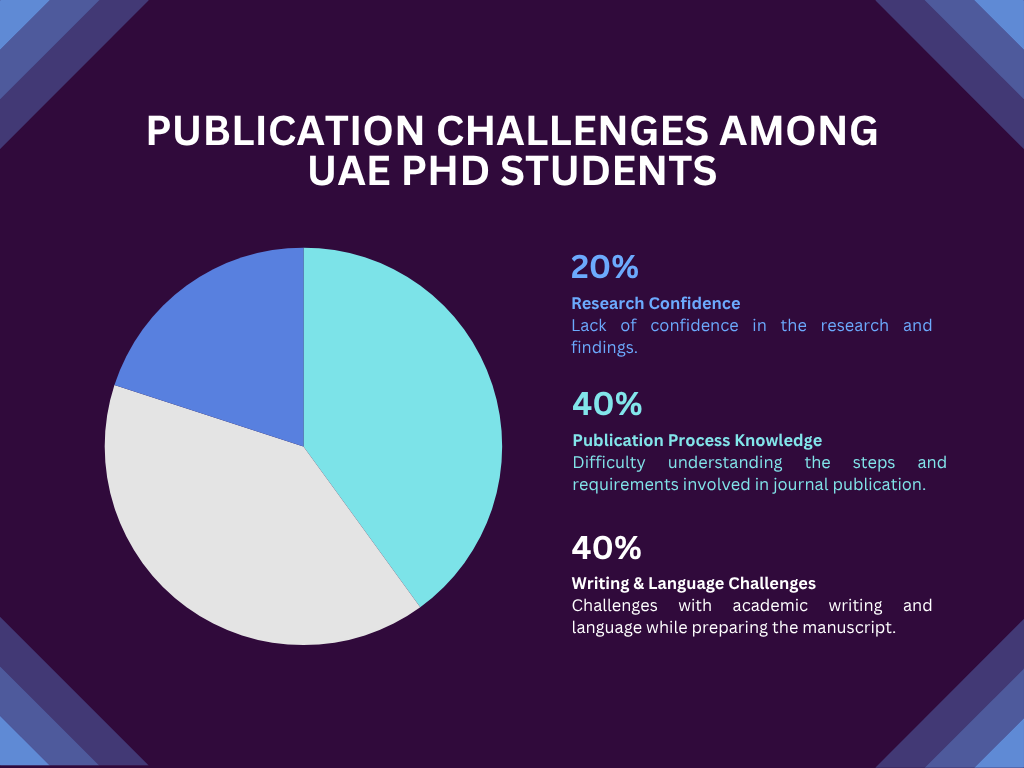
Case Study of a research-intensive university in Dubai that students with doctorate degrees are studying at, will give us an idea of some of those issues. The study examined 176 doctoral students and received 89 responses of which 10 were interviewed to gain insight into the experiences of the students.
Among the respondents, the main reported barriers were:
| Publication challenge | Reported percentage |
|---|---|
| Lack of knowledge of the publication process | 36% |
| Writing skills | 20% |
| Lack of confidence in research and findings | 18% |
| Language concerns | 16% |
These figures come from a specific university-based study, so they should not be taken as representing every PhD student in the UAE. Still, they provide a useful picture of the kinds of research publication challenges students may experience.
1. Not Understanding the Publication Process
The number one issue may be that you don't know how to get things published in a journal.
A first time author may have the skill to do research but not be accustomed to what happens after the paper is submitted. Familiarize yourself with the terms used such as editorial review, peer review, revision and rejection.
Lack of knowledge of publishing process was identified as the most often reported barrier in the case study (36%).
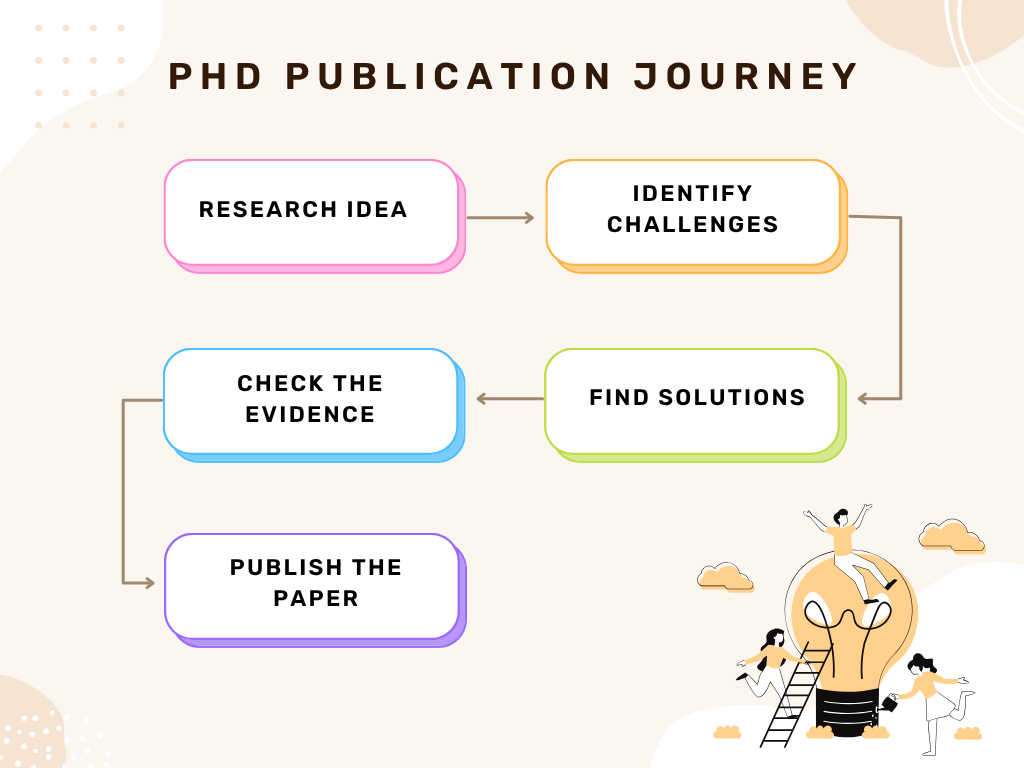
The simple path to a publication is somewhat like this:
Familiarity with these phases can help to make the process less daunting.
It also lets students understand that it's not the end of the paper. It may take a manuscript several drafts to be accepted.
2. Turning Doctoral Research Into a Journal Paper
There are some differences between a PhD thesis and a journal article.
A thesis may be lengthy due to the fact that it has to showcase the research procedure in great detail. A journal article should have a much more focused and precise topic.
This is a common problem, when students attempt to publish their doctoral work.
In the process they might have to make a choice:
- Which research question should be the focus?
- Which findings are most important?
- What information can be shortened?
- Which parts of the literature review are actually needed?
- How should the findings be presented for the journal's audience?
A paper can be too long and off-topic if it's attempting to do more than one thesis. A more useful strategy is to find a specific study, research question or findings and then identify a specific contribution that it makes to that specific area.
3. Choosing a Suitable Journal
The search for a journal doesn't have just one way to find it—you have to look for one that has a similar title to the research topic.
At first, it might seem like a good match, but after reading the scope and more recent publications, it might not be a good choice for a journal.
Students should review the following before submission of the research paper:
- The journal's subject area
- Its stated scope
- The type of research it publishes
- Recent papers
- Submission requirements
- Peer-review information
- Publication charges
- Editorial information
- Claimed indexing
It may be useful to read a number of recently published papers. It helps students to get a clearer understanding of whether his/her own research would be appropriate for that journal.
4. Checking Journal Indexing Carefully
The index can be confusing, especially for students who are presenting their first paper.
The claim may be made in a journal that it is indexed in a specific database, but the student should verify this claim by consulting the database indexing source.
This is relevant if there are specific expectations of a university, employer or academic programme for research publications.
Pupils should also avoid journals that would promise them unrealistic publication. Normally a short review period or guaranteed acceptance should not be interpreted as a positive.
Research should be conducted in a legitimate journal that is appropriate for the research.
5. Writing the Paper in a Clear Academic Style
Another important aspect of academic publishing is writing.
In the UAE case study, 20% of the respondents mentioned that writing was a barrier, while 16% cited language concerns.
The difficulty for some students is not so much comprehending their own research but the difficulty of knowing how to do it. The challenge comes in the ability to communicate it clearly in a journal format.
A good manuscript should be easy to read:
- What the study is about
- Why the research was needed
- What methods were used
- What was found
- What the findings mean
- How the research contributes to the field
The use of complex words throughout sentences is not indicative of good academic writing. Good writing tends to be simpler than needless writing.
6. Confidence in the Research and Fear of Rejection
Not all difficulties are engineering difficulties.
The case study indicated that 18% of the respondents indicated a lack of confidence in their research and findings as a publication hurdle.
If you are a PhD student in the process of writing your first manuscript, it is very tempting to continually ask yourself if your research is "good enough" to write about.
This can be exacerbated by fear of rejection. A student may be reluctant to submit due to concern about criticism from reviewers.
Rejection does not necessarily indicate that the research is of little value. Paper rejection may be due to incompatibility of the paper with the journal, lack of explanations, methodological questions, or not being part of the journal's focus.
By learning how to respond to reviewers' comments as a means to becoming more confident researchers, students can benefit from this experience.
7. Balancing Work, Research and Publication
Time can be one of the most practical challenges that can be experienced during doctoral research.
In the UAE case study, 67.4% of respondents taking part were part-time doctorate students, and 72% held a full-time job. These conditions may restrict research activities outside of the class, the study commented.
For a working PhD student, publishing has to fit all around other work-related duties:
- Job responsibilities
- Coursework
- Research activities
- Data collection
- Meetings with supervisors
- Thesis writing
- Personal commitments
This means that writing manuscripts is easily neglected.
Students do not have to wait for a full week or month to do free publications, but can split them into smaller tasks. One week might be used to organise references, another to revise the introduction and another to work on the discussion.
Small progress is still progress.
8. Research Methodology and Statistical Analysis
In some cases, PhD research challenges start before the manuscript is written.
Research design and implementation are critical factors in the quality of a paper. Students will be required to solve problems, as appropriate to the topic, with the following:
- Data collection
- Sample size
- Data quality
- Statistical analysis
- Research instruments
- Interpretation of findings
- Access to research data
- Ethical requirements
As discussed in the research on public health challenges in the UAE, the statistical and data-analysis problems are complex, especially with specialized data sets and research needs.
That is why it is important to begin preparing for publication at the start of writing. The strongest manuscripts are typically based on good research choices that were made a long time ago.
9. Research Ethics and Publication Ethics
Another aspect that students will not want to miss is ethics.
Students might require adequate ethical clearance prior to data collection, contingent on the study. They should also take into account issues of consent, privacy, and the responsible use of research information.
At the point when the research is published, other ethical issues arise, such as:
- Plagiarism
- Duplicate publication
- Data fabrication
- Data manipulation
- Authorship disputes
- Conflicts of interest
- Submitting the same paper to more than one journal
Such problems can have more severe repercussions than a manuscript rejection. Students should therefore be aware of the requirements for research at their university, as well as the policies of the journal.
10. Moving From Conference Presentation to Journal Publication
Presenting research at a conference can be a crucial way in which a researcher's development is fostered, but it is not the same as publishing a Journal article.
The UAE case study revealed that 35% had participated and given presentations at academic conferences, and 11% had published in journals, book chapters or conference proceedings.
This reflects that there is scope for students to extend their conference work.
A presentation can be made to a conference and can be used to get feedback and to pinpoint areas that can be improved. The study can then be expanded into a more powerful manuscript to send to a journal.
It is always important to verify, however, the policies of the appropriate journal and conference before presenting or publishing material that has already been presented or published.
11. Responding to Reviewer Comments
The first step in the process of publishing the doctorate research is to get through the submission.
Major and minor suggestions may be given to students when they get comments back. Some may request further explanation, some may question the methodology, analysis or interpretation.
A simple way to manage the revision is to create a response table:
| Reviewer comment | Your response | Change made |
|---|---|---|
| Comment 1 | Explain how you addressed the issue | Mention the revised section |
| Comment 2 | Provide clarification or supporting evidence | Identify the change |
| Comment 3 | Explain your reasoning if you disagree | Give a clear justification |
The aim is not to argue with reviewers. It is to show that every comment has been considered carefully.
12. What If the Research Paper Is Rejected?
It is disheartening when a student has spent months working on a paper, only to have it rejected.
The first reaction shouldn't be to send somewhere else the same piece of paper.
Instead:
- Read the editor's decision carefully.
- Go through the reviewer comments.
- Identify the major concerns.
- Decide which changes can improve the paper.
- Reconsider whether the journal was a good fit.
- Revise the manuscript.
- Find another suitable journal if necessary.
- Adapt the paper to the new journal's requirements.
The UAE case study also revealed students' concerns of rejection and uncertainty of publishing.
What is critical is to learn from the decision and not consider it the end of the research.
13. Understanding Publication Costs
Consideration of the costs for publishing can also be part of the decision-making process.
The article processing charge is a fee for publishing articles, especially in open-access journals. Some others may not ask authors to pay for their publication.
Students are advised to review the information available about the journal before submitting:
- Article processing charges
- When payment is required
- Available waivers
- Discounts, where applicable
- Any additional publication charges
The quality and relevance and credibility of the journal should be taken into account along with publication cost while selecting the journal to publish the article.
14. Authorship and Supervisor-Student Concerns
Research at the doctoral level may entail collaboration by more than one person. Other researchers may be involved in the research, analysis or manuscript, and may be involved with the supervisor or co-supervisor.
This may raise issues regarding:
- Who should be listed as an author?
- Who should be the corresponding author?
- What should the author order be?
- Who should be acknowledged?
These issues should be addressed at the beginning of the research and in conformance with the authorship guidelines and institutional policies of the relevant authors.
It can cause a lot of conflict to have the conversation at the end of the paper when it is time to submit.
How Can UAE PhD Students Make Publication Easier?
The case study highlights the need for enhanced training, mentoring, supervision and structured support for doctoral students. Students interviewed in the research also added that practical assistance, e.g., publication workshops, advice on procedure and possibilities to develop research for publication could be helpful.
Students have the option of doing a number of steps themselves:
Start Thinking About Publication Early
Don't leave it to the end of your PhD to consider where your work may be published.
Understand Your University Requirements
There may be variations in publication expectations across programmes, so students need to be aware of what it is their programme expects.
Talk to Your Supervisor
Talk through what aspects of your research might be suitable to publish and what kind of journals might be pertinent.
Read Published Papers
By reading papers in the target journal you will get an idea of the style, structure and expectations of the target journal.
Plan for Revisions
It may take longer than anticipated to publish. Provide time for comments from the reviewers, revisions, and resubmission if necessary.
Keep Improving
Every paper, critique of the manuscript, and research presentation can aid you in getting more comfortable with academic publishing.
Frequently Asked Questions
What are the common challenges in research paper publication for UAE PhD students?
Some common difficulties are publication process, academic writing, language issues, confidence in research, journal choice, time constraints, research methodology and handling reviewers.
When should PhD students start thinking about publication?
Although it is preferable to consider publication while conducting research than after the thesis is finished. This will allow students more time to consider appropriate research outputs, and to become familiar with the requirements of journals.
Is a PhD thesis the same as a journal article?
No. A thesis is generally much more detailed, while a journal article usually focuses on a specific research question, study or set of findings.
How can I choose the right journal for my research?
Visit the scope, recent publications, submission guidelines, review process, indexing details and publication fees of the journal. The journal should be a genuine match for your research.
What should I do after a research paper rejection?
Read the decision and reviewers comments carefully, make necessary revisions to the manuscript and re-evaluate the journal appropriateness. If applicable, rewrite the paper and resubmit it to a different appropriate journal.
Conclusion
For PhD students, the process of research publication in the UAE could be difficult for myriad reasons. It can begin with an understanding of how a journal works and branch out as you go into the writing, journal selection, methodology, peer review, revisions and time management.
The UAE doctoral case study is especially valuable because it demonstrates that publication problems are not just based on the quality of the research. Students may have a lack of publication experience, writing skills, confidence, and language issues that all impact their experience.
To make publishing a part of the PhD from early on is best. Know how it works (be careful selecting journals, talk to your supervisor about your desire to publish, give them time to consider your work and suggest revisions).
Research should have a clear roadmap for publication and knowing that roadmap can make it a lot less daunting for doctoral researchers.